Article 50: what advertisers actually have to label
The AI Act’s labelling rules have applied since 2 August 2026. They are narrower than the headlines suggest in one respect and wider in another — and half of them are not your job at all, but your vendor’s.
The short version
- Article 50 has applied since 2 August 2026. The Digital Omnibus changed nothing about that — only the high-risk obligations moved.
- The machine-readable mark is your vendor’s job. Your tooling has to do it; you do not.
- You only have to label deep fakes visibly — but you have to do it even when you were not trying to mislead anyone.
- The next date is 2 December 2026, when the grace period ends for tools that were already on the market before August.
The AI Act was delayed. The labelling rules were not.
The most common misreading of the last fortnight, and the one worth clearing up first.
On 27 July 2026 the Digital Omnibus — Regulation (EU) 2026/1744 — entered into force. It postponed the AI Act’s high-risk obligations substantially: standalone high-risk systems under Annex III move to 2 December 2027, and AI embedded in regulated products under Annex I to 2 August 2028.
It did not amend Article 50 of the AI Act. The transparency obligations — chatbot disclosure, marking of synthetic content, and deep-fake labelling — took effect on 2 August 2026 exactly as originally scheduled.
So if the takeaway from the Omnibus coverage was that the labelling duties slipped, that is wrong. They are live now. What follows is our reading of what they require of an advertiser, with the Commission’s own FAQ and transparency guidelines linked so you can check it.
Two duties, two different parties
The single most useful thing to understand: the machine-readable mark and the visible label are separate obligations, and they do not fall on the same person.
| Article | What it requires | Who carries it | When it bites |
|---|---|---|---|
| Art. 50(1) | People must be told they are interacting with an AI system, unless it is obvious to a reasonably observant person. | Providerthe company that builds the AI system | Chat and voice interfaces. Rarely relevant to a video ad. |
| Art. 50(2) | Synthetic audio, image, video and text must be marked in a machine-readable format and detectable as artificially generated or manipulated. | Provideryour AI tooling vendor, not you | Every generative output, with exemptions for assistive editing that does not substantially alter the input. |
| Art. 50(4) | Content constituting a deep fake (deepfake) must be disclosed as artificially generated or manipulated, clearly and distinguishably. | Deployerthe advertiser running the ad | Where the output resembles real people, places, objects or events and would falsely appear authentic. |
Verify a file’s Content Credentials
Article 50(2) asks for a machine-readable mark. Drop an ad here to see what it declares about AI, who signed it, and whether the mark really belongs to that file — all checked in your browser.
Where the line actually falls
The visible-disclosure duty is narrower than “label all AI” — and it bites in places people assume are safe.
Not every AI ad needs a visible label
Article 50(4) is about deep fakes, not about AI involvement in general. A stylised product animation, a generated background plate, or an AI-assisted cut of footage you actually shot does not automatically trigger a visible disclosure. The machine-readable mark under 50(2) is a separate matter and applies far more broadly.
Intent to deceive is not required
This is where teams get caught out. The obligation attaches to content that resembles real persons, objects, places or events and would falsely appear authentic to a reasonable observer. Whether you meant to mislead anyone is irrelevant — a photorealistic AI presenter in a testimonial-style ad is in scope even if nobody was trying to fool anyone.
A real person does not have to be depicted
The definition covers existing objects, places and events too, and content resembling a plausible-but-invented person can still read as authentic. “We invented the face, so it is not a deep fake” is not a safe reading.
Assistive editing is carved out
Where the AI performs an assistive function for standard editing and does not substantially alter the input data, the Article 50(2) marking duty does not apply — the Commission’s guidelines enumerate the carve-outs. Colour grading, trimming, captioning and reframing your own footage sit on the safe side of that line.
Artistic and satirical work gets a lighter touch
For evidently artistic, creative, satirical or fictional work, the disclosure must be made in an appropriate manner that does not hamper the display or enjoyment of the work. It is a softer requirement, not an exemption.
Nothing published before 2 August is retroactive
Ads that went live before the obligations applied do not need to be relabelled. The duty attaches going forward.
What it costs to get this wrong
Article 50 is not a code of conduct. It sits inside the AI Act’s penalty regime like everything else.
€15m or 3%
Up to €15 million or 3% of worldwide annual turnover, whichever is higher — Article 99(4)(g).
The Commission does not enforce this. National market surveillance authorities do. In Germany the KI-Durchführungsgesetz, in force since 29 July 2026, designates the Bundesnetzagentur as the central market surveillance authority and point of contact.
The split in the table above is also the split in liability: the visible label under Article 50(4) is the advertiser’s to get right, not the tool vendor’s. Buying compliant tooling does not discharge it.
How the fine is actually set
Article 99(4)(g) sets a ceiling, not a starting point. Authorities weigh the nature, gravity and duration of the breach, whether it was negligent or deliberate, and what was done to remedy it. For SMEs and small mid-caps the cap is the lower of the two figures rather than the higher.
Why the Code of Practice matters even though it is voluntary
Adherence to the Commission’s Code of Practice on Transparency of AI-generated Content, published on 10 June 2026, is treated as evidence that your approach meets the obligation. Non-signatories are not in breach for that reason alone, but carry the burden of demonstrating an equivalent result by other means.
The dates that matter
Two of these have passed. The one most teams have not planned for is in December.
| Date | What happens | Who it affects |
|---|---|---|
| 27 July 2026 | Digital Omnibus (Reg. EU 2026/1744) enters into force, deferring the high-risk regime — and leaving Article 50 unchanged. | Everyone, mostly as a source of confusion |
| 2 August 2026 | Article 50 transparency obligations apply in full. | Providers and deployers |
| 2 December 2026 | Grace period ends for AI systems placed on the market before 2 August 2026, which until then are exempt from the Article 50(2) marking and detection duty. | Providers — and anyone relying on an older tool |
| 2 December 2027 | Deferred high-risk obligations for standalone Annex III systems begin to apply. | High-risk deployers — not ordinary ad production |
What a compliant label actually looks like
“Disclosed” has a specific meaning. The label goes in the asset, and it has to be there the moment someone sees the content.
Does not count
- The post caption or the video description.
- Metadata alone — a viewer must not need a tool to find it.
- A line in your terms, or a disclosure page linked from the ad.
- A brand watermark or logo bug. That identifies you, not the AI.
Counts
- A legible “AI generated” or “AI modified” mark burned into the frame. Synonyms are fine.
- The Commission’s own EU icon set — three variants for AI-involved, fully AI-generated and partially AI-modified.
- Anything perceivable at first exposure, clear of overlays, that survives resharing and download.
Is the EU icon mandatory?
No. Using the icon is optional; labelling is not. The icon exists so that a compliant label looks the same across the market, and signatories of the Code of Practice commit to its placement specification. Your own wording is equally valid if it is as clear.
Placement and persistence, in practice
The Code of Practice expects the disclosure to be perceivable at the latest on first exposure, not obscured by overlay elements, and to survive resharing and download. For video that means a mark carried in the frame rather than an end card — a viewer who sees only the first three seconds has still been told.
The machine-readable half is a different problem
A visible mark does nothing for Article 50(2), and a single watermark does not satisfy it either. The Code expects a layered approach: cryptographically signed metadata, an imperceptible watermark, and a fallback for short or heavily re-encoded clips where a watermark will not survive. That duty is the provider’s, which is why it has to be applied at export rather than reconstructed afterwards.
Where you declare AI on each ad platform
Meta, TikTok, YouTube and Google Ads each ask you to declare AI-generated content in their own upload flow. These are the controls, and where to find them.
| Platform | What you declare | Where the control sits |
|---|---|---|
| Meta | Whether the ad contains photorealistic AI-generated or digitally altered imagery or audio. Meta also applies its own “AI info” label when it detects industry provenance signals such as C2PA or IPTC metadata. | Ads Manager, on the ad-level creative form; organic posts carry the same toggle in the composer. |
| TikTok | That the content is AI-generated, which adds a visible “AI-generated” tag to the post. TikTok also reads C2PA Content Credentials on upload and applies the tag automatically when it finds them. | The “AI-generated content” switch under Post settings, and in TikTok Ads Manager for paid placements. |
| YouTube | That the video contains realistic altered or synthetic content, which surfaces a disclosure in the description or on the player. | The “Altered content” question in the Studio upload flow, on the Details step. |
| Google Ads | Synthetic content in political and election advertising, which Google requires to be disclosed in-ad. | The election-ads certification flow, plus the in-ad disclosure you author yourself. |
These are contractual platform rules, not the AI Act, and each platform changes its own on its own schedule — check the current help page before you build a process on any single row. They also apply worldwide rather than only in the EU, so a declaration made here does not replace the Article 50(4) label in the frame, and the label does not replace the declaration.
How Solid covers both halves
We ship the provider-side obligation ourselves and give you a one-toggle answer to the deployer-side one.
C2PA Content Credentials
Solid detects, declares and cryptographically signs AI provenance on exported assets, and scans uploads for existing C2PA metadata so generated material from tools like Veo or Sora is recognised on the way in. That is the Article 50(2) duty, and it is ours rather than yours.
How we shipped it
“Generated with AI” watermark
A per-export toggle burns a clear, visible mark into the delivered video. Where an ad falls within Article 50(4), that is the disclosure, applied at export rather than bolted on in post.
How we shipped it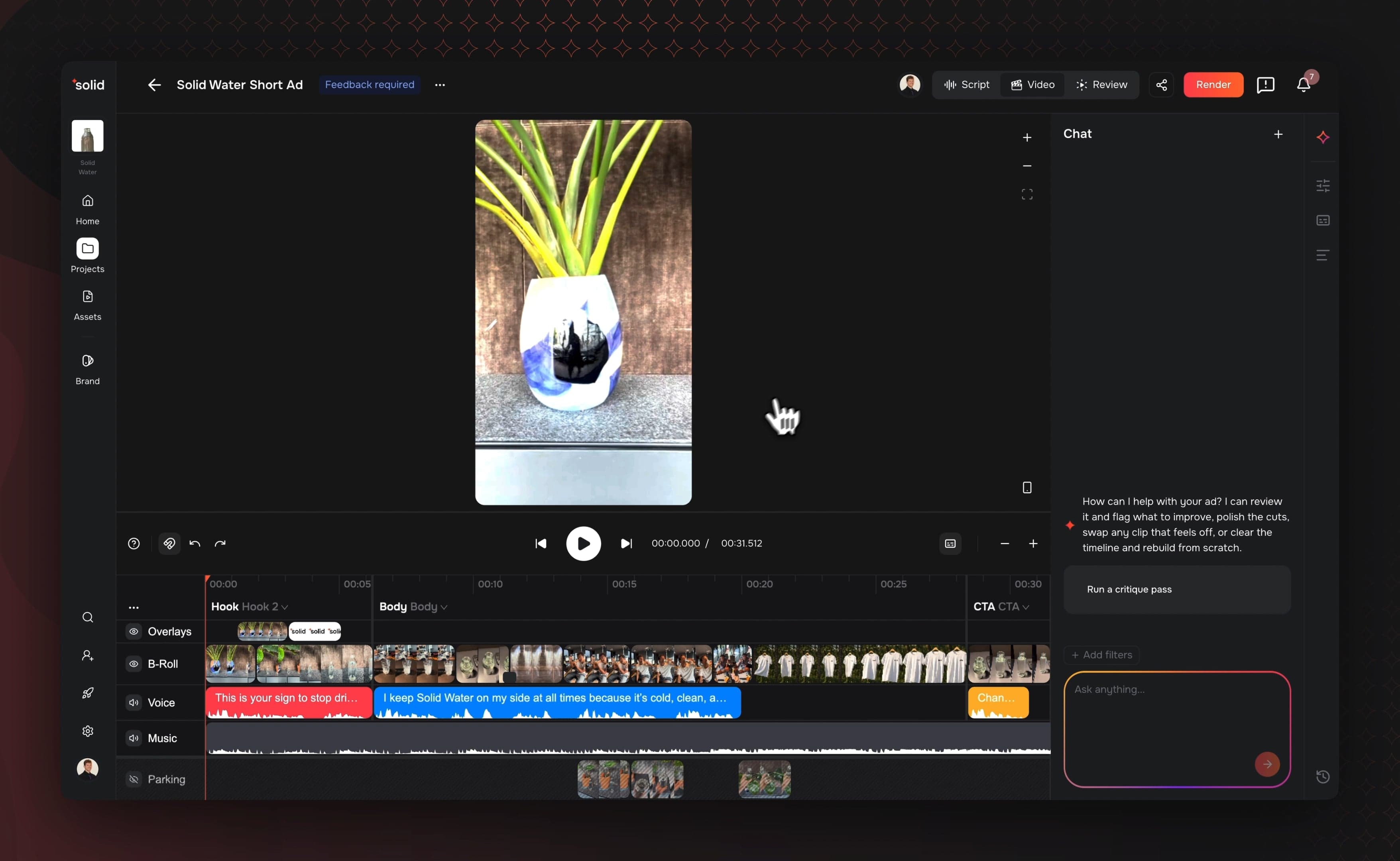
Per-asset AI status you can audit
Every clip carries its AI status through the timeline, and you can declare or retract it manually. When someone asks which of last quarter’s ads contained generated material, the answer is in the project rather than in somebody’s memory.
FAQs
Questions we are actually getting
Does every ad with any AI in it need a visible label?
No. The visible-disclosure duty in Article 50(4) applies to deep fakes (deepfakes) — content resembling real persons, objects, places or events that would falsely appear authentic. AI used to cut, grade, caption or reframe footage you shot yourself does not trigger it. The machine-readable marking duty under Article 50(2) is separate, applies more broadly, and falls on your tooling vendor rather than on you.
Didn’t the EU just delay the AI Act?
It delayed the high-risk regime. The Digital Omnibus entered into force on 27 July 2026 and moved Annex III high-risk obligations to December 2027 and Annex I to August 2028. It left Article 50 alone, so the transparency and labelling rules applied on 2 August 2026 as originally planned.
We use an AI avatar as a presenter. Are we in scope?
Yes. A photorealistic presenter that a viewer would take for a real person is the central case Article 50(4) was written for, and it applies whether or not you intended to deceive anyone. The Commission’s guidelines are explicit that an invented person counts: a realistic synthetic depiction of someone who does not exist is still a deep fake, because such a person plausibly could exist. “We made the face up” is not a way out.
What about ads we published before August?
They do not need relabelling. The obligations apply going forward from 2 August 2026 rather than retroactively to content already live.
Is a watermark enough on its own?
It depends which watermark and which duty. For Article 50(4), a clear and distinguishable visible mark carried in the frame is what the obligation asks for — but a brand watermark or logo is not one, because it identifies you rather than the AI. For Article 50(2) a single watermark is not sufficient at all: the Code of Practice expects signed metadata and an imperceptible mark together, so that the signal survives re-encoding. You need both halves, which is why Solid does one and offers the other.
What happens on 2 December 2026?
The grace period ends for AI systems that were already on the market before 2 August 2026. Until then those systems are exempt from the Article 50(2) marking and detection duty; from December they are not. If part of your stack is an older tool, that is the date to ask its vendor about.
Does this apply to us if we are outside the EU?
The AI Act reaches providers and deployers whose systems or outputs are used in the EU, so running ads to an EU audience can bring you within scope regardless of where the team sits. Where exactly the line falls for a given setup is a question for your counsel, not for a vendor page.
Is this legal advice?
No. This is our reading of the regulation as a company that had to implement against it, published because customers kept asking. The Commission’s own FAQ and transparency guidelines are linked below, and anything consequential should go past your own lawyers.
Labelling belongs in the export, not in post
Nobody shipping hundreds of variants a campaign can check each one by hand for whether a watermark was needed and whether the metadata is right. That is why we put both in the pipeline: Solid carries every clip’s AI status through the timeline, signs provenance automatically, and applies the visible mark at export — for one ad exactly as for three hundred.
Solid is AI video ad production for performance teams. Brands including Waterdrop, Refurbed and HOLY use it to scale their best-performing ads.
Sources
- European Commission — Transparency obligations under Article 50 (FAQ)
- European Commission — Guidelines on transparency obligations for providers and deployers
- European Commission — Code of Practice on Transparency of AI-generated Content
- European Commission — EU icons for labelling AI-generated content
- AI Act — Article 50, full text
- AI Act — Article 99, penalties
This page describes how we read the AI Act’s transparency obligations while building against them. It is information, not legal advice, and it is not a substitute for your own counsel.